

Crypto Bloodbaths: An Insider’s Guide to Reading Liquidation Cascades
Deconstructing Open Interest, On-Chain Flows, and Order Book Fragility Before the Market Unravels

It’s not just a loss. A mass liquidation is the simultaneous, forced death of thousands of leveraged positions when the market finally turns on them. And these aren’t quiet deaths—they are automated market orders, huge ones, slammed into an order book that suddenly has no bids. They devour available liquidity, shove the price down further, and trigger the next wave of liquidations. A feedback loop from hell.
This process creates those violent, gut-wrenching wicks on the chart. A cascade that can wipe out weeks of gains in minutes, all because the market got too greedy. It’s a purge. An absolutely necessary, brutal purge of excess leverage.
The sequence is always the same, a tired old script. First, the optimism, the cheap funding, the traders piling on leverage like there’s no tomorrow. Then, the shock. Could be anything—a piece of news, a fat-fingered institutional order, a sudden liquidity pull. That first sharp move triggers the margin calls. And because most retail is levered to the absolute hilt, they can’t meet them.
So the system takes over. The exchange’s engine starts force-closing positions. Automatically. This fires off massive sell orders, which hammers the price, which triggers more liquidations. And on and on it goes until the leverage is flushed out. An explosive, self-perpetuating demolition.
Where this happens matters. On a CEX, the liquidation engine runs against their own order book. Your fate depends entirely on their solvency and their servers not crashing. In DeFi, it’s a different beast—on-chain liquidations run by bots pinging smart contracts. You escape centralized custody, sure, but you walk right into a new set of risks. Slow or manipulated oracles, slippage in shallow AMM pools, and the dark forest of MEV where bots fight over gas to front-run your liquidation for a profit. Frankly, DeFi liquidations are just a more complex, less transparent way for bots to fleece over-leveraged degens.
Understanding this dynamic… this brutal market mechanism… helps you see the tension building. It lets you read the signs and maybe, just maybe, get out of the way before the floor gives out. We’re talking about funding rates, real liquidity, and making defensive plays when things get sketchy.
So how do you read the tea leaves?
Interpreting a coming liquidation cascade means figuring out where the risk is hiding. Who is over-leveraged? Which side of the boat is too crowded? At what price point does all hell break loose? Answering this lets you make real decisions: cut exposure, dial back leverage, protect your capital, or—if you’ve got the stomach for it—look for entry points after the bloodbath.
So let’s break down what an analyst actually looks at. Before, during, and after. We’re talking leverage concentration, the breaking points, the real sell pressure, and the actual, available liquidity. Together, they paint a picture of not just what’s happening, but why.
1. Pinpoint the Leverage Pile-Up (OI + Funding)
What to watch:
- Aggregated open interest (OI) across the big boys—Binance, Bybit, OKX. Compare it to spot volume. For the institutional view, you glance at CME Group or Deribit.
- The average funding rate per exchange. Is it deviating wildly from its 24-72 hour mean?
- Direction. Is funding positive (longs paying shorts) or negative (shorts paying longs)?
Why it’s critical:
OI is just the total number of open derivatives contracts. When it rockets up, disconnected from reality, it signals a massive build-up of leverage. But OI alone is dumb. It could just be market makers hedging or arbitrage plays. You have to pair it with funding and basis to get the real story.
Funding tells you which side is paying a premium to stay in their position. Extreme readings—either way—show a dangerous collective bias. Combine that with sky-high OI, and you have a market that is incredibly vulnerable. A tiny adverse move can set off the entire chain reaction.
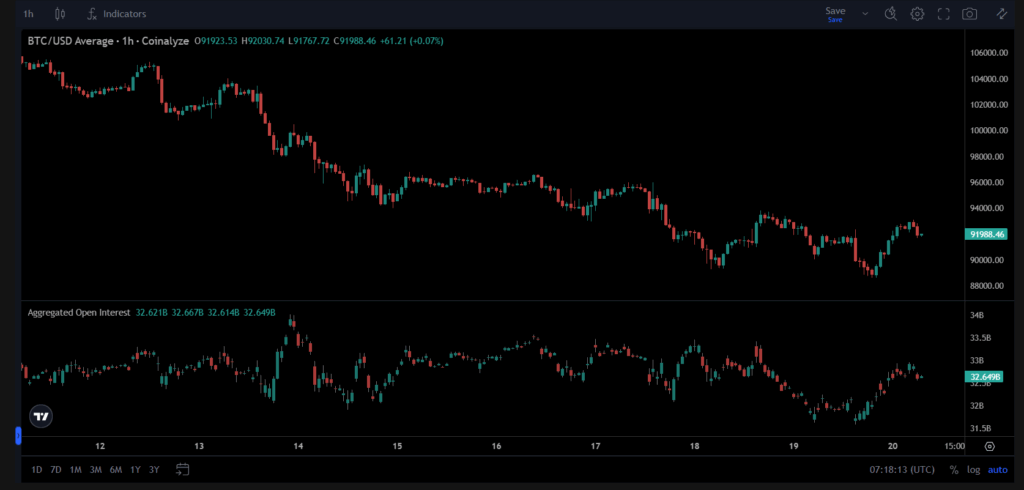
Look at the relationship between price and OI. When both fall off a cliff together? That’s not profit-taking. That’s forced closures. That’s a liquidation cascade in action. Source: Coinalyze
2. Find the “Breaking Points” (Liquidation Heatmaps)
What to watch:
- The visual maps showing where potential liquidations are clustered.
- How dense are the contracts in a tight price range?
- Do these clusters line up across different exchanges?
Why it’s critical:
Heatmaps show you the minefield. They visualize where the most vulnerable positions are stacked up. When too many traders have similar liquidation prices, you get a “breaking point”—a price level that, if touched, unleashes a torrent of forced market orders simultaneously. This is what turns a normal pullback into a flash crash. The brightest, densest clusters are the kill zones. One bad candle into that zone and it’s game over.
3. Gauge the Real Sell Pressure (On-Chain Flows)
What to watch (on-chain metrics):
- Net flows of crypto into and out of exchanges.
- Sudden changes in total exchange reserves.
- Big movements from whale wallets straight to trading platforms.
Why it’s critical:
On-chain flows to exchanges are a direct signal of intent. Nobody sends a huge bag of BTC or ETH to an exchange just to look at it. They’re planning to sell. If you see these inflows happening while the market is already top-heavy with leverage, you have the perfect storm. The forced liquidations are the spark, but these real sellers are the gasoline. The combination results in those aggressive, support-shattering candles and blown-out spreads.
4. Check the Real Liquidity (Book Depth + Spreads)
What to watch (how to measure):
- Order book depth at different price levels, especially within ±0.5% or ±1%.
- Sudden, weird changes in the bid/ask spread.
- Slippage estimates for executing a medium to large order.
Why it’s critical:
When the market gets nervous, market makers and other participants pull their limit orders. The book gets thin. Dangerously thin. With less liquidity on the book, any large order—especially an automated liquidation—causes a massive price move because it just chews through multiple price levels. This is slippage. It accelerates the crash and can push the price right into the next cluster of liquidations. Understanding the real depth of the book tells you if a drop is going to be caught or if it’s going to fall into a “liquidity vacuum.”
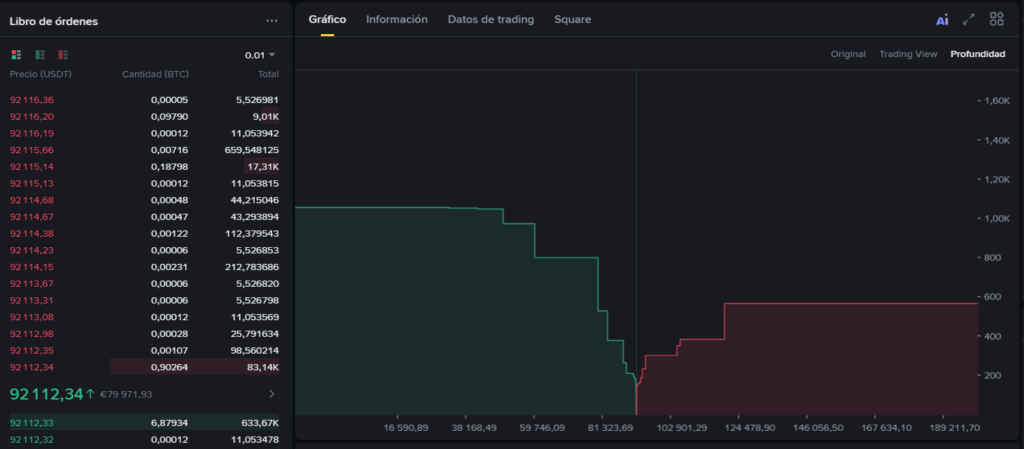
The order distribution shows how much real liquidity exists at each price level. A thin book like this is an amplifier for violent moves. Source: Binance
No single indicator screams “CRASH!” The key is confluence. Reading the whole picture. When you see excess leverage, clear liquidation clusters, heavy on-chain inflows, and a thinning order book all at once… the market is fragile. It’s primed. Having a dashboard that tracks these layers lets you react before the break, not after.
The Simpler Signals: Street Smarts for Market Weakness
Forget the advanced indicators for a second. Sometimes the market screams weakness in much simpler ways. These are the quick-and-dirty tells that anyone can spot. They’re an immediate gut check that something is wrong, even before you pull up the fancy charts.
A) The price drops like a stone with stupidly large candles.
When you see drops of over 5% in a few minutes, or 10%+ in under an hour, that’s not normal selling. Normal selling is choppy. This is different. This is the machine at work—forced sales and automated liquidations. The speed and uniformity of the drop is the giveaway. It’s a cascade.
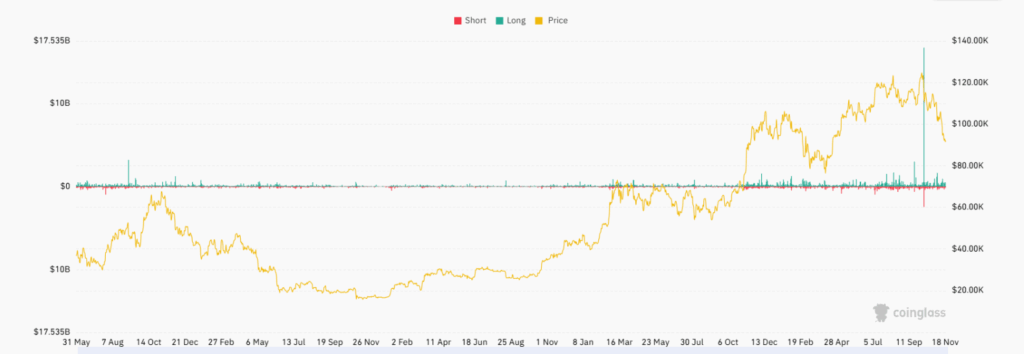
Spikes in long and short liquidations show how built-up leverage fuels forced selling and accelerates price moves. It’s a self-feeding monster. Source: CoinGlass
B) Volume goes ballistic while the price craters.
If volume bars suddenly shoot up to 2-3x their 24-hour median during a sharp drop, that’s panic. It’s mass executions, automated closures, and a desperate scramble for the exits. This pattern shows the drop isn’t natural; it’s being accelerated by forced selling into an order book that can’t handle the pressure. Sometimes, huge volume can mark a capitulation bottom… but you better be damn sure before you try to catch that knife.
C) The bid/ask spread blows out.
Simple. Powerful. The gap between the best buy price and the best sell price suddenly gets way wider than normal. This happens when liquidity providers pull their orders to avoid getting run over. The market becomes hollow. Any decent-sized order can now move the price violently. This is an early warning sign of fragility, often appearing seconds or minutes before the real move.
D) Perps decouple from spot.
In moments of extreme stress, the price of the perpetual futures contract will detach from the spot price, creating a huge premium or discount. This gap shows that leverage is stacked heavily in one direction and those traders are losing control. When the perp leads the spot with exaggerated moves—faster, wider—it’s a clear sign of stress. Part of the market is being forced out, and it’s destabilizing everything. It’s like the Byzantine navy deploying Greek fire; a chaotic, uncontrollable weapon that burns everything in its path.
E) Social media is screaming “X millions liquidated!”
A sudden explosion of posts about liquidations is an emotional thermometer. It’s not precise technical data, but it’s a great signal of collective stress. But be careful. It’s noisy, full of bots, and easily manipulated. Use it as a secondary confirmation, not primary evidence. Retail is always the last to the party and the first to get liquidated. It’s the natural order of things.
So, What Do You Do?
During a cascade, different players react based on their own game. These are common market behaviors, not advice.
Long-term buyers often pause, check that the exchange is even working, and try to distinguish a leverage flush from a real fundamental shift. Sellers—like market makers—are checking book stability and on-chain flows to see if more selling is coming down the pipe.
Some buyers will scale in, distributing their buys to avoid getting wrecked by volatility. Sellers are adjusting their order sizes and placement, trying to manage their inventory without getting steamrolled.
Leverage becomes everything. Active traders are frantically checking their exposure and margin levels. Institutions are hedging and monitoring their net exposure, balancing the need to provide liquidity with the risk of the market falling apart.
And then there’s cash. Some buyers keep capital in liquid assets, ready to deploy. Sellers use their operational liquidity to restock inventory. Time horizon is the final guide. Long-term players see these events as market cleanings, not structural breaks. Short-term players are just trying to survive.
This post is for informational and educational purposes only. It is not financial advice, an investment recommendation, or a suggestion to trade. Every market participant must evaluate their own situation and consult a qualified professional if needed.


