

Bitcoin Dips Below $80,000 as Macro Headwinds and Selling Pressure Mount
The cryptocurrency faces pressure from inflation data and trade tensions, triggering $2.3 billion in liquidations despite a historically strong February.

Bitcoin’s price fell below the key $80,000 technical support level on the final day of January, tumbling to a low of $75,000—a price point not seen since April 2025. The cryptocurrency later staged a modest recovery, trading back above $78,000 at the time of publication.
From a technical standpoint, the breach of the $80,000 mark, which had previously held firm during a correction two months ago, signals weakening demand. If selling pressure persists, the market could retest the $74,000 level. A more significant downturn could see prices revisit the broader consolidation range between $49,000 and $73,000, established before the initial breakout above $80,000 in November 2024.
The downturn rippled through the broader cryptocurrency market, hitting the futures segment particularly hard. The move triggered approximately $2.3 billion in liquidations of leveraged positions betting on price increases, marking the largest such event since a market retreat from all-time highs in October.
Historically Favorable February
The recent weakness comes in contrast to Bitcoin’s historically strong performance in February. Since 2013, the month has closed with losses only three times: a 31.03% drop in 2014, an 8.6% decline in 2020, and a 17.39% fall in 2025. In all other years, February has been a bullish month, fueling some expectation of a potential seasonal rebound.
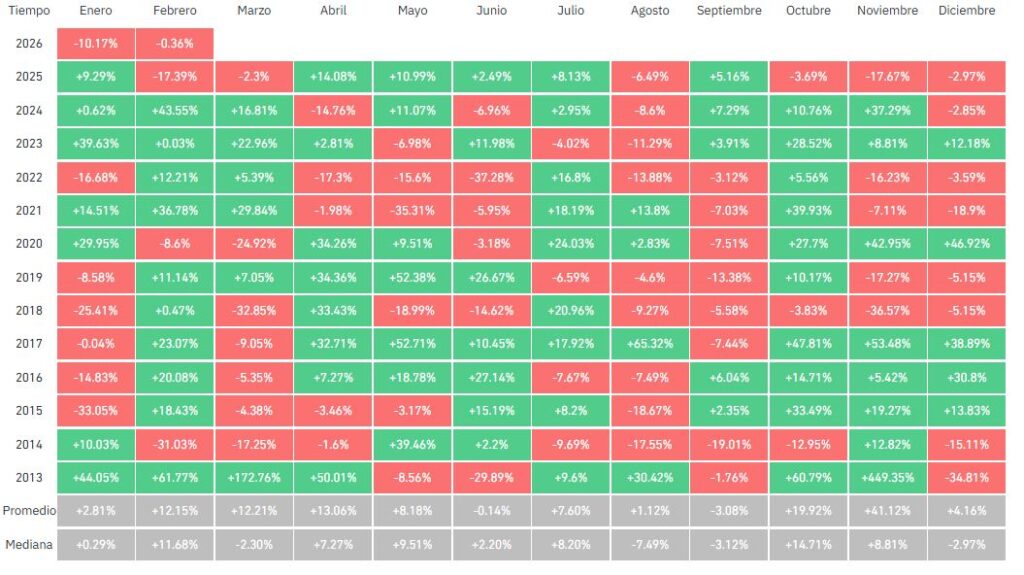
However, seasonality alone may not be enough to reverse the trend if the macroeconomic environment continues to deteriorate.
Inflation, Rates, and Trade Tensions
Mounting macroeconomic pressures are casting a shadow over financial markets, including digital assets. Investor risk appetite has soured amid concerns over a potential tariff war between the United States and the European Union.
Compounding these worries, recent U.S. inflation data has limited the Federal Reserve‘s flexibility. The Producer Price Index (PPI) for December rose 3.0%, exceeding the 2.7% forecast, while core inflation climbed to 3.3%, above the expected 2.9%. These figures suggest that persistent production costs could hinder a sustained slowdown in overall inflation.
As long as inflation remains elevated, the Fed has less room to consider interest rate cuts—a scenario that typically strengthens the dollar and dampens enthusiasm for risk assets like Bitcoin. In his latest press conference, Fed Chair Jerome Powell stated that the labor market has stabilized but acknowledged that inflation, despite some moderation, remains at high levels.
Selling Pressure and Cycle Analysis
Ki Young Ju, CEO of CryptoQuant, attributed Bitcoin’s decline to persistent selling pressure and a lack of new capital entering the market. He pointed to the PnL Index Signal, an indicator measuring aggregate unrealized profits and losses, which shows that realized capitalization has stagnated.
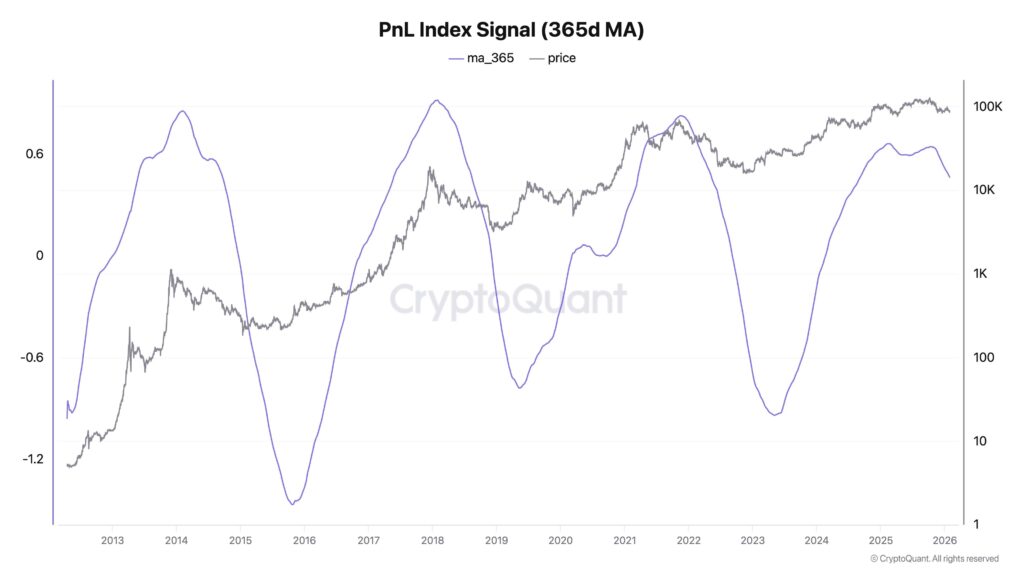
According to his analysis, this indicates an absence of fresh inflows, and a falling market capitalization in this environment is not consistent with a bull market. Ju noted that early investors, including those who bought through exchange-traded funds (ETFs) and Strategy’s (ticker MSTR) accumulation, are sitting on substantial unrealized gains. These inflows, which helped support prices near $100,000 for much of last year, appear to have dried up.
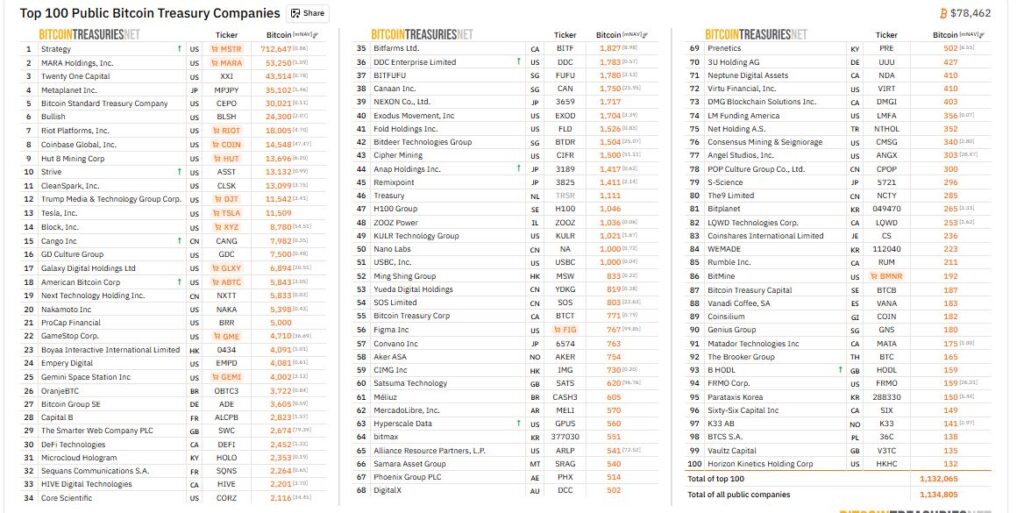
However, Ju considers a 70% crash, similar to those seen in previous cycles, to be unlikely unless Michael Saylor’s Strategy initiates significant sales. Strategy is the largest corporate holder of Bitcoin, with a treasury of 712,647 BTC valued at approximately $55.91 billion. In his base case scenario, Ju anticipates the bear market will unfold as a prolonged sideways consolidation rather than a sharp, abrupt collapse.
As the market enters February, traders are watching to see if historical seasonality can provide a tailwind for Bitcoin. The asset’s performance will likely hinge on external factors, including inflation trends, the Federal Reserve’s monetary policy, and the fallout from global trade tensions. Without a resurgence of capital inflows, February’s historically positive track record may not be enough to counter the current market pressure.


